25 April 2026
About us
A summary of the DSR history.
Dutch Synthetic Reefing
This article was published in Coral magazine edition juli/aug2015 (and many other translations). It illustrates how the Dutch Synthetic Method came to be. From experimenting with a own salt mixture to understanding reef chemistry setting new rules and developing a novel reef keeping method without waterchanges and the minimal required use of equipment, making it a low maintenance reef-keeping method. DSR does not blindly mimic natural seawater, but set it’s own rules based on many experiments and proven result for coral diversity and growth.
The Dutch Synthetic Method (DSR) is a revolutionary approach to marine aquarium keeping that challenges the conventional wisdom of mimicking natural seawater parameters and performing frequent water changes. Instead, DSR advocates for creating a synthetic seawater environment that is tailored to the specific needs and preferences of the corals and other reef inhabitants. DSR relies on precise measurements and adjustments of various chemical elements, such as calcium, magnesium, alkalinity, nitrate, phosphate, and trace elements, to achieve optimal water quality and stability. DSR also minimizes the use of equipment, such as skimmers, reactors, and dosing pumps, to reduce costs and maintenance.
DSR was developed by Glenn Fong, a Dutch reef hobbyist who started experimenting with his own salt mixtures in 2009. He discovered that by adding certain elements to his saltwater, he could improve the health and growth of his corals without changing the water. He also found that some elements were unnecessary or even harmful for his reef system. He shared his findings and methods with other reefers on online forums and social media, and soon DSR became a popular and successful reef keeping method in the Netherlands and beyond.
This article traces the history and evolution of DSR, from its humble beginnings as a personal experiment to its current status as a widely recognized and respected reef keeping method. It also explains the basic principles and practices of DSR, as well as its advantages and disadvantages compared to other methods. Finally, it showcases some of the stunning reef tanks that have been created using DSR, demonstrating its potential for achieving coral diversity and growth.
No water changes
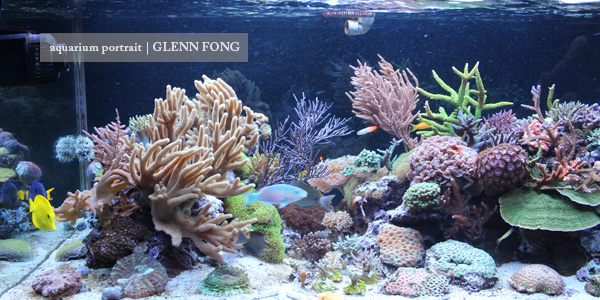
Until I contracted the Human Saltwater Virus in December 2004, my current 370-gallon (1,400-L) aquarium was a freshwater tank inhabited by Malawi cichlids. After a lifetime of keeping freshwater aquaria, I dove headlong into something totally new. I removed the fishes, drilled a hole in the bottom of the tank, plumbed a sump into the system, and filled the tank with salt water. Thus began my marine adventures and my unorthodox route to a thriving reef aquarium a decade later.
From the start I never did water changes—I had not changed the water in my freshwater tanks either. I started with the usual soft corals, a few large-polyp stony corals, and some easy small-polyp stony corals. I built my own skimmer and calcium reactor, and for a while all went quite well—until I start putting more demanding small-polyp corals into the tank.
In 2008 I lost a few stony corals due to an inadequate calcium reactor that could not keep up with the corals’ appetites, so I built a larger one and introduced new SPS corals. Then, at the end of 2010, I lost the majority of my stony corals when multiple things went wrong: a reverse osmosis unit stopped doing its job, the calcium reactor started acting up, and a 130-gallon (500-L) tank of nonphotosynthetic (NPS) corals that I had connected to my reef started crashing. In retrospect, I realized that the NPS tank was a mistake: on top of the calcium problem, I had a sky-high phosphate level (0.64 ppm) in my reef tank. I was so discouraged that I decided to give up the hobby. I left the tank running with minimal care and went on a 30-day vacation to Thailand in mid-2011.
Next try
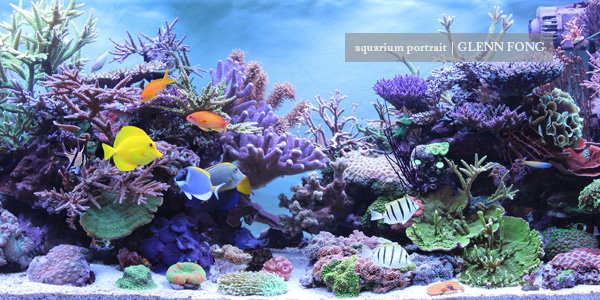
In November 2011, I decided to give it another try. This time I was determined to do it right. After reading about water chemistry I chose to make my own reef salt. To test my results, I filled a 2.6-gallon (10-L) fishbowl with my own saltwater blend and added some small frags. I was pleasantly surprised when I noticed some growth in this little tank, so after two months I replaced 118 gallons (450 L) of water in the big neglected reef tank with my own synthetic salt water. (This water had not been changed since 2004). I chose to do the water change because I could not lower my phosphate level, which remained between 0.16 and 0.64 ppm, with granular ferric oxide (GFO). The synthetic water contained no phosphate, so adding it diluted the phosphate concentration. This was just enough to reverse the downward spiral that had begun, and I started stocking the reef with SPS and LPS coral frags again.
During the following six months I start measuring and controlling as many parameters as possible using the minerals I used to compose the synthetic salt. All went well, and my phosphate and nitrate levels sunk to being unmeasurable. After a while, however, some corals were growing and others turning pale. Eventually all of them turned pale, started to bleach, and lost tissue from the bottom up. I nearly lost a complete colony of Green Birdsnest Coral, Seriatopora caliendrum. There were only a few branches left, which I fragged and mounted on a small rock. After a long while I decided this was not the way to go, so I started dosing the reef tank with phosphate (0.08 ppm) and nitrate (2.5 ppm).
Lessons learned
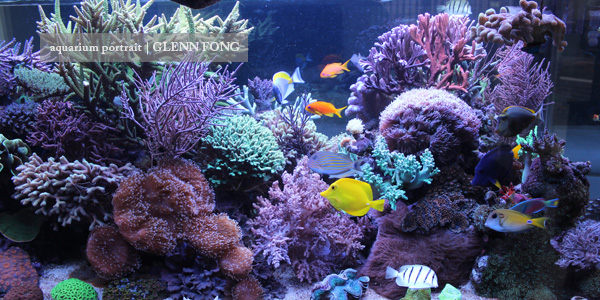
This was a valuable lesson: that you can actually take nitrate and phosphate levels too low. To my surprise, all of the corals regained their polyps and color and started growing again. For a while I was playing with the phosphate and nitrate levels to see what worked best and noted that corals reacted differently to different levels. I decided that controlling phosphate and nitrate, as well as the other parameters, was the key to success. Between January 2012 and today I have fine-tuned my water parameters and learned a lot about corals and their needs.
I call my method of keeping a reef without water changes the Dutch Synthetic Reefing method, and I now market a line of reef supplements under the DSR Technics brand.